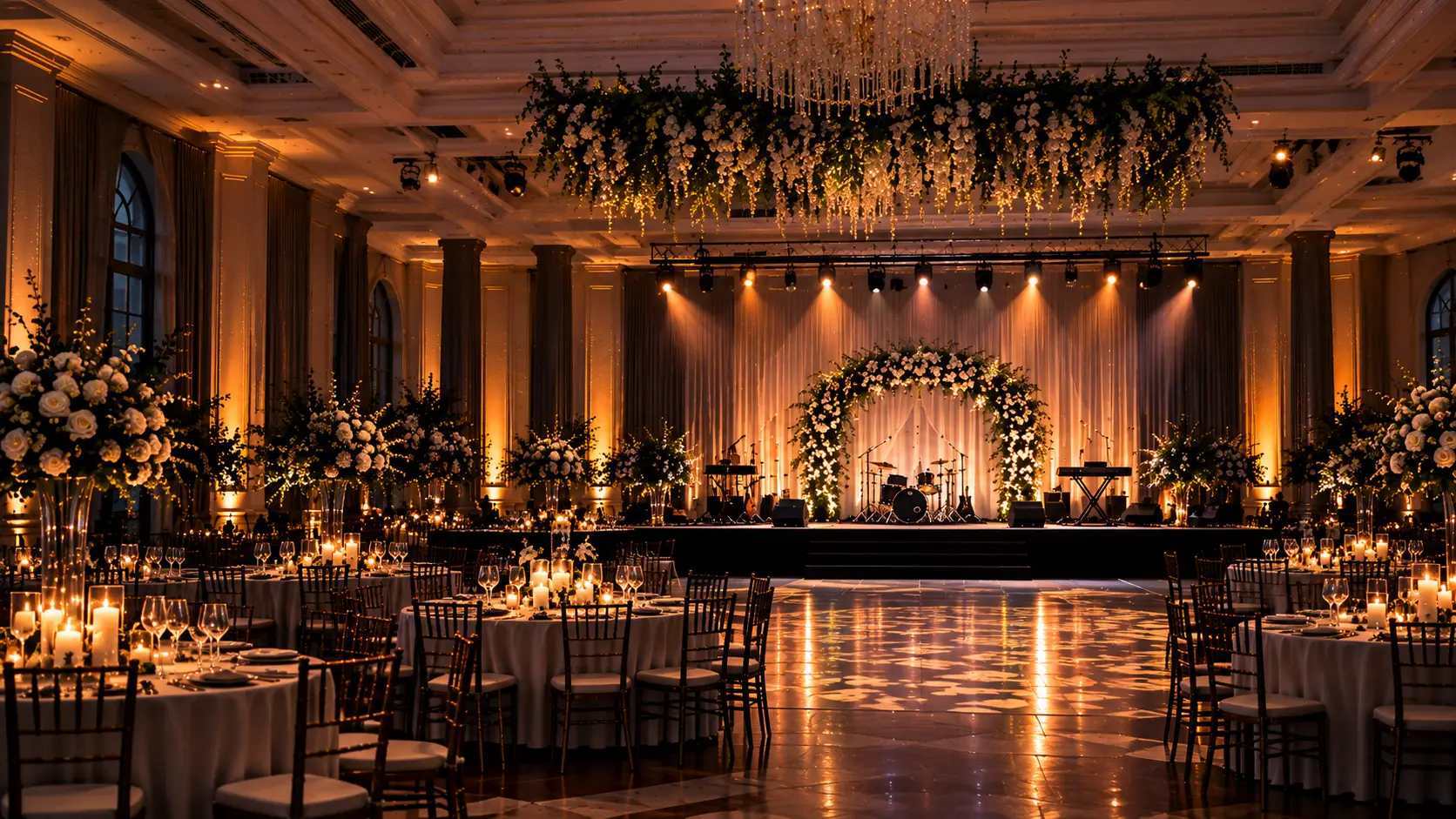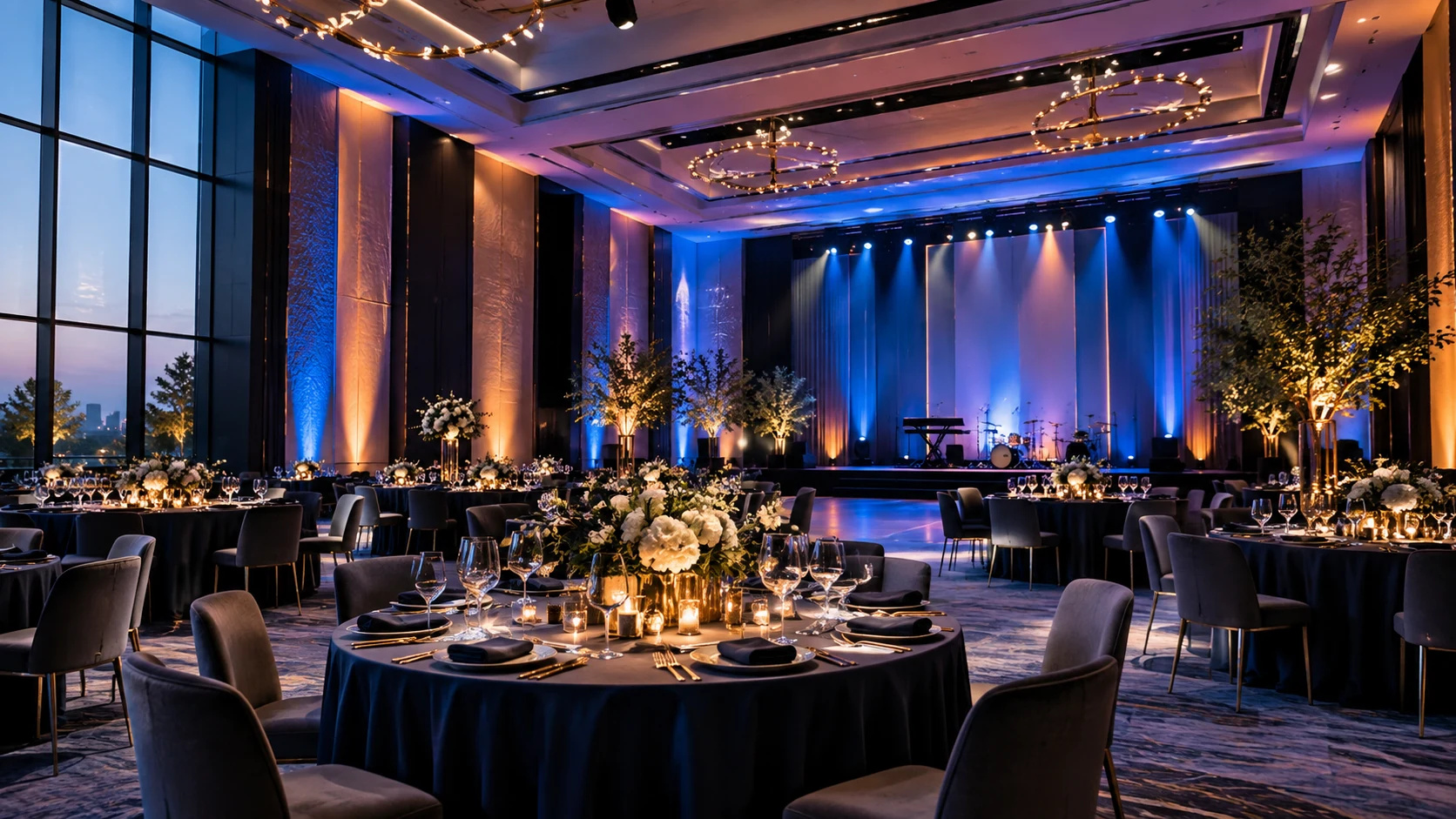
If you run an event lighting company, you probably already have something most businesses would love to have:
Work that looks good on camera.
The challenge is turning that work into a marketing system that consistently helps the right people discover you, trust you, inquire, and book.
That means going beyond "post more on Instagram." Your strongest marketing opportunities can come from your completed events, Google presence, website, venue relationships, referrals, educational content, and follow-up process.
Get your free visibility audit →
Here are 15 practical event lighting marketing ideas—and, more importantly, how to use them as part of a connected system.
The Short Answer
The most useful event lighting marketing ideas are:
- Turn every event into multiple marketing assets.
- Build location-specific content.
- Optimize your Google Business Profile.
- Create venue-specific lighting content.
- Build relationships with venues and planners.
- Show before-and-after transformations.
- Create educational lighting content.
- Turn portfolio projects into case studies.
- Build a review-generation system.
- Turn client questions into content.
- Use Pinterest for visual discovery.
- Create useful service and event-specific landing pages.
- Follow up with previous inquiries.
- Build a deliberate referral system.
- Measure which marketing activities actually produce bookings.
But don't try to implement all 15 at once.
Start with the part of your marketing system that is currently weakest.
The LitBooked Marketing Ideas Framework
Instead of treating these as 15 unrelated tactics, organize them into five jobs:
- GET FOUND — Help the right prospects discover your company.
Google • Local SEO • Pinterest • Social • Location-specific content
- GET TRUSTED — Show them why your company deserves consideration.
Portfolio • Reviews • Case studies • Transformations • Education
- GET REFERRED — Become visible inside the event ecosystem.
Venues • Planners • DJs • AV companies • Event professionals
- GET CONTACTED — Make taking the next step easy.
Website • Service pages • Proof • Inquiry forms • Clear CTAs
- GET BOOKED — Turn interest into an actual opportunity.
Response • Quotes • Follow-up • Sales process This is the important distinction:
A marketing idea is only useful when you know what job it is supposed to perform.
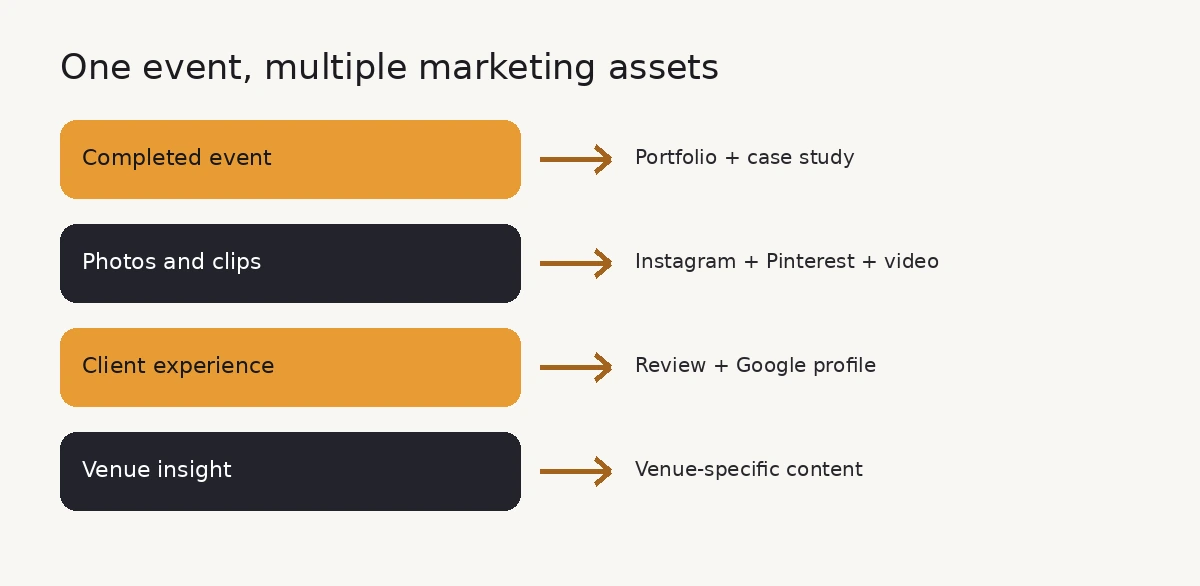
1. Turn One Event Into Multiple Marketing Assets
One completed event shouldn't become one Instagram post and disappear.
A single wedding, corporate event, gala, or private celebration can become:
- A before-and-after post
- A portfolio project
- A short-form video
- A venue-specific lighting idea
- An educational post
- A Pinterest pin
- A Google Business Profile photo
- A client testimonial
Think: 1 Event → Multiple Assets → Multiple Discovery Opportunities You already did the difficult part: you created the work.
Now extract more marketing value from it.
2. Build Location-Specific Marketing
Your potential customers don't always search broadly for an event lighting company.
They may search for:
Event lighting company in Dallas Wedding lighting in Orlando Event lighting near me Corporate event lighting in Miami Uplighting company in Atlanta That means your marketing should clearly communicate what you do and where you do it.
Create useful location-specific pages and content around your actual service areas.
But don't simply create dozens of pages where only the city name changes.
A useful local page should contain genuinely relevant information—appropriate services, event types, examples, venues, FAQs, and a clear next step.
Local relevance is more useful than repeating a city name.
3. Optimize Your Google Business Profile
For a local event lighting company, your Google Business Profile should make three things obvious:
What you do. Where you work. What your work looks like.
Keep your profile accurate and complete, and regularly add relevant project photography.
Think beyond equipment photos.
Show: Venue → Lighting Design → Finished Atmosphere Your profile should help someone understand the experience your company creates before they ever visit your website.
4. Create Venue-Specific Lighting Content
This is one of the most useful ways to combine marketing with venue relationships.
Instead of simply posting:
"Wedding at XYZ Venue" create something more useful:
"5 Lighting Ideas for Weddings at XYZ Venue" Show how you would approach that particular space.
For example:
Large ballroom: architectural uplighting and focused table illumination.
Outdoor venue: perimeter lighting, pathways, and reception lighting.
Industrial venue: architectural highlighting and controlled accent lighting.
This type of content can serve two audiences at once: potential clients looking for ideas, and venues looking for lighting partners.
5. Build Relationships With Venues and Planners
The people already involved in planning events can become valuable sources of qualified opportunities.
But a generic message such as:
"Hi, we're an event lighting company. Please keep us in mind." is easy to ignore.
Instead, research the venue or planner first. Then create something useful.
For example:
"We looked at your reception space and identified three lighting approaches that could work particularly well for evening weddings." Now you're demonstrating that you understand their environment.
The relationship-building process becomes:
Research → Create Value → Introduce → Demonstrate → Follow Up → Build Relationship You're not simply asking for a referral. You're becoming useful.
6. Show Before-and-After Transformations
Lighting is naturally suited to transformation marketing.
Don't only show the finished room. Show what changed.
Before: a visually flat space.
After: architectural illumination, focused areas of light, defined event zones, and a stronger atmosphere.
This answers a question potential clients often have:
"What difference will lighting actually make?" A finished photograph shows the result. A transformation shows the value of the lighting decision.
7. Create Educational Lighting Content
Not every piece of content needs to sell.
Teach potential clients something they genuinely want to understand.
For example:
How much lighting does a wedding reception need?
What is the difference between uplighting and pin spotting?
What lighting works in a dark ballroom?
How can lighting make a venue feel more intimate?
When should event lighting be planned?
What lighting works for corporate events?
What should you ask an event lighting company?
How much does event lighting cost?
Educational content can help establish expertise before someone ever submits an inquiry.
8. Turn Portfolio Photos Into Case Studies
A photograph proves that you completed an event. A case study shows how you think.
Use a simple structure:
Event → Space → Challenge → Lighting Approach → Result For example:
"A large wedding reception space felt visually flat after sunset. The lighting design used warm perimeter illumination, focused table lighting, and a defined dance-floor area to create stronger visual separation throughout the room." Now the prospect isn't just looking at a photograph. They're seeing your problem-solving process. That distinction matters.
9. Build a Review System
Don't leave reviews entirely to chance.
Create a consistent process for requesting feedback after successful events.
Strong genuine reviews can reinforce things prospects care about:
- Communication
- Professionalism
- Reliability
- Setup
- Quality of work
- Overall event experience
And make sure genuine reviews remain genuine.
Don't manufacture testimonials or script claims for customers.
The goal is to make it easy for satisfied clients to share their real experience.
10. Turn Client Questions Into Content
Your sales conversations are a source of marketing ideas.
If prospects repeatedly ask:
"Do we really need uplighting?" that's a content topic.
If they ask:
"Can lighting work in our outdoor venue?" that's another.
If they ask:
"How much lighting will our reception need?" that's another.
Create a simple internal list: Questions Prospects Keep Asking Then turn those questions into:
Articles → FAQs → Videos → Social Posts → Pinterest Content → Sales Resources This gives your content a direct connection to real customer concerns instead of forcing your team to constantly invent topics.
11. Use Pinterest for Visual Discovery
Event lighting is highly visual, making Pinterest useful for inspiration-driven discovery.
Create content around specific ideas such as:
Wedding reception lighting ideas Ballroom lighting ideas Vineyard wedding lighting Outdoor wedding lighting Romantic uplighting ideas Corporate event lighting Luxury wedding lighting But don't stop at the image.
Each useful visual should lead somewhere:
Pinterest → Relevant Article → Website → Inquiry That turns visual inspiration into a potential website visit.
Free calculator
Lead value calculator
See what your enquiries are worth today, and what a small lift in conversion adds over a year.
The last figure shows how much more you would book each year if your conversion rate rose by two percentage points.
12. Create Useful Service and Event-Specific Landing Pages
A single generic services page may not answer every prospect's question.
Depending on your business, useful pages might focus on:
Event Lighting + City Wedding Lighting + City Corporate Event Lighting + City Lighting for a Specific Event Type Each page should have a genuine purpose.
Include relevant services, examples, FAQs, locations, proof, and a clear next step.
Don't create hundreds of nearly identical pages simply to target keywords.
Create pages because they are useful to people—not because you can change a city name.
13. Follow Up With Previous Inquiries
A prospect who didn't book immediately isn't necessarily a permanently lost opportunity.
Look at your previous inquiries and identify situations such as:
No response Still deciding Event postponed Date changed Lost on price Chose another provider Outcome unknown Then follow up with something useful.
Instead of:
"Just checking in." try:
"We recently completed a reception similar to yours and thought the lighting approach might be useful for your event." Or answer a question they previously had.
Good follow-up gives the prospect a reason to continue the conversation.
14. Build a Deliberate Referral System
Think about everyone already connected to the events you want:
Wedding planners Venues DJs AV companies Photographers Event producers Corporate event professionals Complementary vendors Then identify which relationships could naturally produce relevant opportunities.
The goal isn't simply:
"Please send us referrals." It's:
"How can we become a useful and memorable partner in your event ecosystem?" That mindset changes the relationship from asking for leads to creating mutual value.
15. Measure What Actually Produces Bookings
Don't measure your marketing only through:
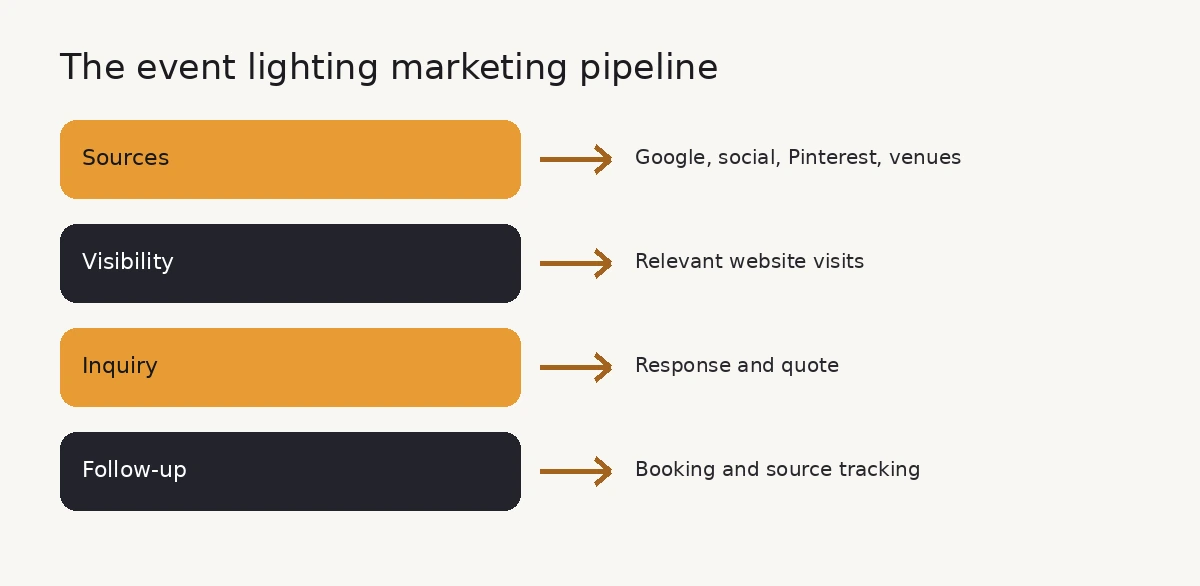
Followers Likes Views Website traffic Track the journey:
Visibility → Visit → Inquiry → Response → Quote → Follow-up → Booking Then record the source of each opportunity.
For example:
| Source | Inquiries | Quotes | Bookings |
|---|---|---|---|
| — | — | — | |
| — | — | — | |
| Venue referrals | — | — | — |
| Planner referrals | — | — | — |
| — | — | — | |
| Direct | — | — | — |
The purpose isn't to create a complicated reporting system.
It's to answer one important question:
Which marketing activities are actually creating business opportunities?
What Most Event Lighting Companies Get Wrong
- ❌ Posting more without knowing why
More content doesn't automatically fix a visibility or conversion problem.
- ❌ Marketing equipment instead of outcomes
Clients aren't primarily buying fixture specifications. They're buying what the lighting creates for their event.
- ❌ Treating Instagram as the entire marketing strategy
Social media can create discovery and proof, but it works better when connected to your website, search presence, and inquiry process.
- ❌ Ignoring venue relationships
Venues and planners are already connected to people planning events. That makes them an important part of the event marketing ecosystem.
- ❌ Creating generic marketing content
"5 Marketing Tips for Small Businesses" could belong to almost any company. "5 Ways a Wedding Lighting Company Can Turn One Venue Into a Recurring Lead Source" is much more specific.
- ❌ Measuring attention instead of opportunities
A post receiving thousands of views isn't automatically producing business. Track what happens after the attention.
What Probably Won't Work
| Approach | What to expect |
|---|---|
| Posting more without a strategy | ❌ Probably won't solve the underlying problem |
| Relying entirely on Instagram | ⚠️ Might work for some businesses, but creates channel dependence |
| Buying traffic before fixing conversion problems | ❌ Can send more people into the same weak process |
| Creating useful local and educational content | ✅ Stronger approach |
| Connecting search + content + proof + relationships + follow-up | 🚀 More complete approach |
The goal isn't to use every channel.
The goal is to give every marketing activity a job.
A Practical 30-Day Starting Plan
Week 1 — Get Found
Review your Google Business Profile, website, service areas, local relevance, and most important search opportunities.
Week 2 — Get Trusted
Turn your strongest events into case studies, transformations, portfolio stories, and genuine review opportunities.
Week 3 — Get Referred
Identify relevant venues and planners and begin personalized relationship-building.
Week 4 — Get Measured
Create a repeatable content process and start tracking inquiries, quotes, bookings, and their sources.
Don't try to perfect everything in 30 days.
Build one improvement, measure it, then improve the next part.
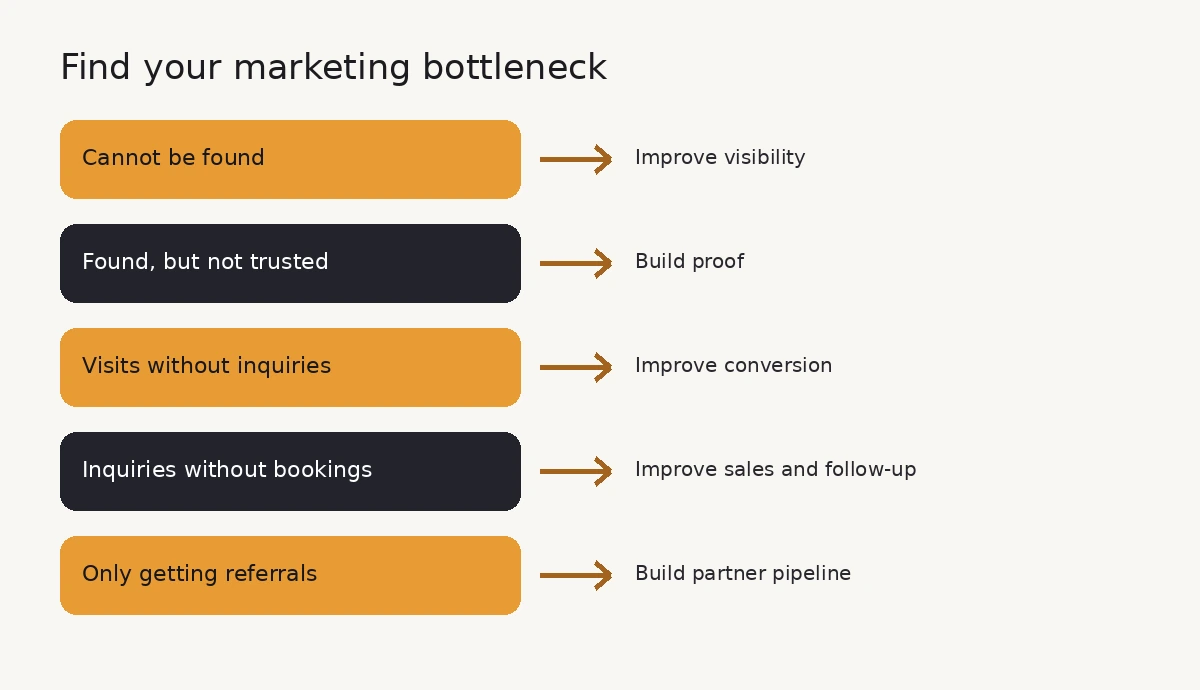
What Should You Work on First?
Can't be found?
Start with local visibility and search.
People find you but don't trust you?
Improve your portfolio, reviews, case studies, and proof.
People visit but don't inquire?
Improve your website messaging, service pages, and conversion path.
Inquiries aren't becoming bookings?
Look at response speed, quoting, follow-up, and the sales process.
You're already getting bookings but relying heavily on referrals?
Build a deliberate venue and partner pipeline.
You don't need to implement every marketing idea today. Fix the biggest gap first.
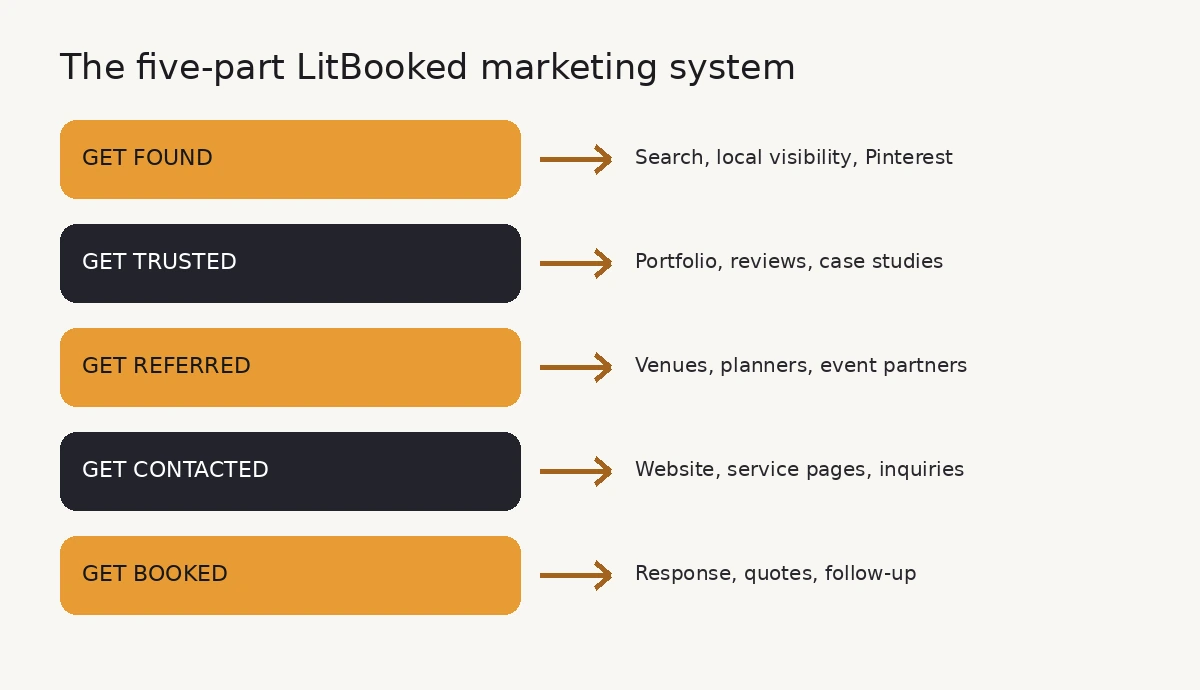
The 5-Part LitBooked Marketing System
The 15 ideas above become much easier to manage when you organize them around five outcomes:
GET FOUND
Search, local visibility, Pinterest, social discovery.
GET TRUSTED
Portfolio, reviews, case studies, transformations, education.
GET REFERRED
Venues, planners, DJs, AV companies, event professionals.
GET CONTACTED
Website, service pages, proof, inquiry process.
GET BOOKED
Response, quotes, follow-up, sales process.
Frequently Asked Questions
What are the best marketing ideas for an event lighting company?
Useful approaches include local SEO, Google Business Profile optimization, venue relationships, educational content, portfolio marketing, social media, Pinterest, genuine reviews, referral systems, and systematic follow up.
How can an event lighting company get more leads?
Start by identifying where existing bookings originate. Then strengthen those channels while improving the stages between discovery, inquiry, quote, and booking.
Should an event lighting company focus on Instagram or SEO?
They serve different purposes. Instagram can provide visual discovery and proof, while search can help people actively looking for relevant services discover your company. They can work together as parts of a broader marketing system.
How can event lighting companies get more venue referrals?
Research relevant venues, understand their spaces, create useful venue specific ideas, and build relationships before asking for referrals.
What should an event lighting company post on social media?
Focus on transformations, completed projects, education, expertise, process, client proof, venue specific ideas, and answers to questions prospects actually ask.
How do I know which marketing idea is working?
Track the journey from marketing source to inquiry, quote, and booking. This helps distinguish attention from actual business opportunities.
The LitBooked Takeaway
You don't need 100 marketing tactics.
You need a marketing system where every activity has a purpose.
Get found. Get trusted. Get referred. Get contacted. Get booked.
Start with your biggest gap, build one improvement at a time, and measure what happens.
Because the goal of event lighting marketing isn't simply to create more content.
It's to create more opportunities for the right clients to discover your work, trust your company, and ultimately book you.