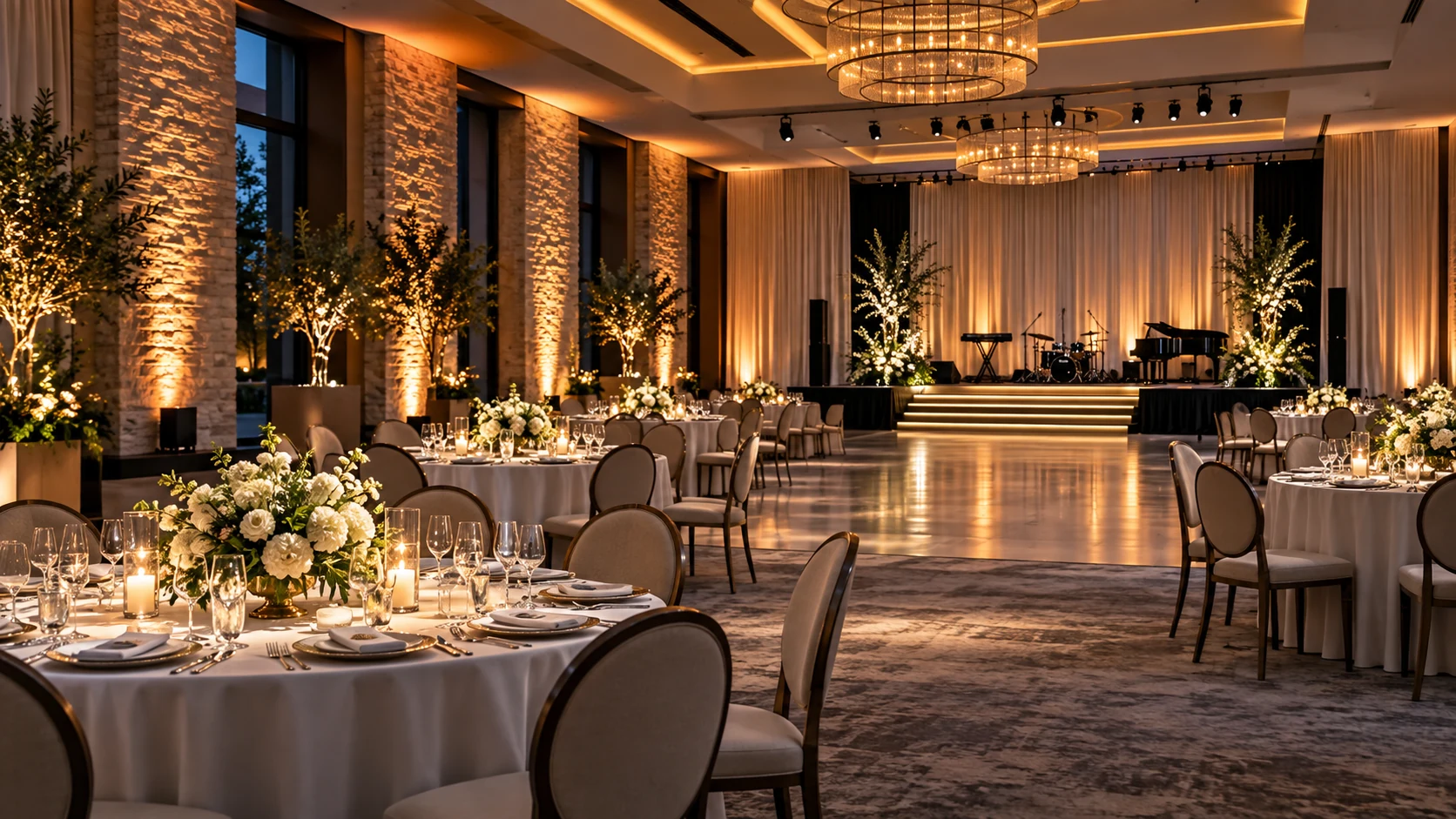
Marketing an event lighting company isn't simply about getting more people to see your work.
You need a system that helps the right people discover you, understand your value, trust your work, contact you, and ultimately book you.
A company can have beautiful event photos and still struggle to generate inquiries.
It can receive website traffic without generating leads.
Get your free visibility audit →
It can have a large social following without a predictable pipeline.
The difference is often the strategy connecting everything together.
This guide shows you how to build that system.
The Short Answer
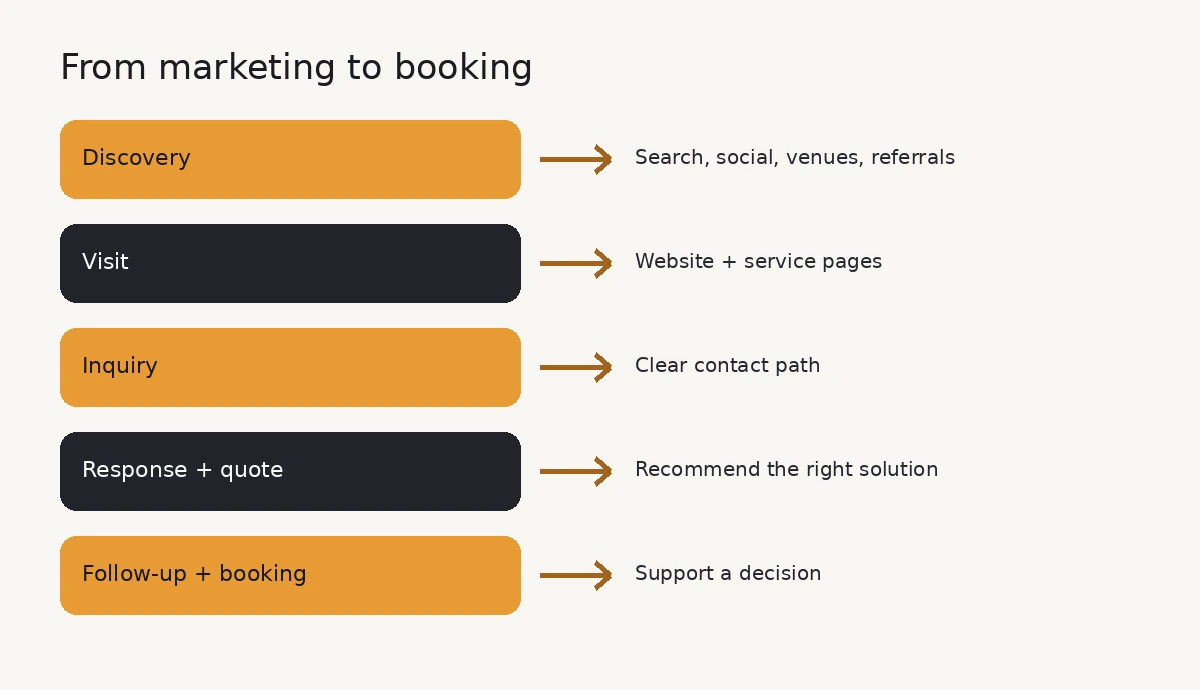
A strong event lighting marketing strategy connects seven stages:
Visibility → Visit → Inquiry → Response → Quote → Follow-up → Booking
Each stage has a job.
Visibility gets you discovered.
Visit gives prospects more information.
Inquiry turns attention into an opportunity.
Response keeps the opportunity moving.
Quote communicates the solution.
Follow-up helps the prospect make a decision.
Booking turns the marketing effort into revenue.
The mistake is treating SEO, Instagram, referrals, websites, and sales as separate activities.
They should work together as one marketing system.
The LitBooked Marketing Strategy Framework
Instead of asking:
"What marketing should our event lighting company do?" ask:
"What does our marketing need to accomplish next?" Organize the strategy around five jobs:
- GET FOUND — Search, local SEO, Google Business Profile, social discovery, Pinterest, and referrals.
- GET TRUSTED — Portfolio, reviews, case studies, transformations, education, and proof.
- GET CONTACTED — Website messaging, service pages, relevant content, strong proof, and a clear inquiry path.
- GET CONSIDERED — Fast response, qualification, recommendations, and professional quoting.
- GET BOOKED — Follow-up, decision support, objection handling, and a consistent sales process.
This turns a collection of marketing activities into a strategy with a purpose.
1. Start With the Right Customer
Before choosing marketing channels, decide who you actually want to attract.
An event lighting company might primarily serve:
- Weddings
- Corporate events
- Conferences
- Galas
- Private events
- Venues
- Event planners
- Event producers
- AV clients
The strategy should change depending on the business.
A wedding-focused lighting company may depend heavily on:
Google + Instagram + Pinterest + venues + planners
A corporate-focused company may need more emphasis on:
Google + corporate case studies + event producers + AV partnerships An AV company that provides lighting may position lighting as part of a broader production solution.
There is no single marketing mix that fits every lighting business.
Start with the customer and event types you actually want more of.
2. Diagnose Before You Add More Marketing
One of the most important strategic decisions is knowing where your current pipeline is breaking.
Take your recent inquiries and record:
- Lead source
- Event type
- Location
- Inquiry date
Response Quote Booking
- Known reason for losing the opportunity
Then look for patterns.
Lots of visitors but few inquiries?
Look at your website, messaging, proof, and CTA.
Lots of inquiries but few quotes?
Look at response speed, qualification, and communication.
Lots of quotes but few bookings?
Look at your offer, quote presentation, objections, and follow-up.
Very few qualified inquiries?
Look at your targeting and visibility.
This gives you a crucial rule:
Don't try to generate more traffic until you understand what happens to the traffic you already have.
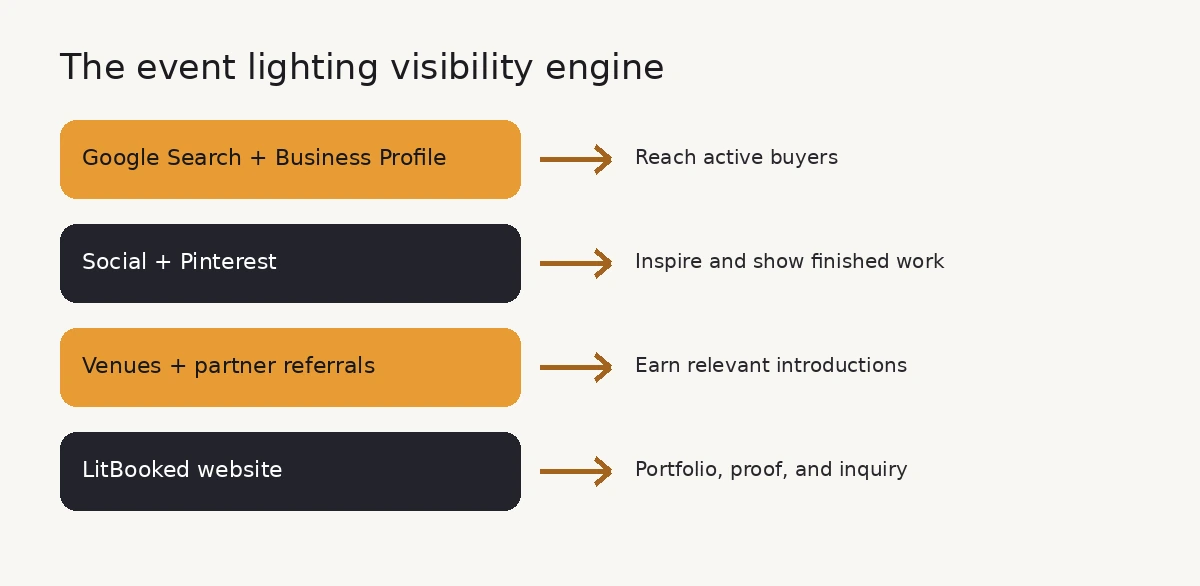
3. Build Your Visibility Engine
Your first marketing job is getting discovered by the right people.
Your visibility engine can include:
Search Create useful content around the services, locations, event types, and questions your prospects actually search for.
Google Business Profile Keep your local presence accurate, relevant, and supported by genuine project photography and reviews.
Social Media Use completed projects, transformations, education, expertise, and process to create visual discovery.
Pinterest Publish useful lighting inspiration for people researching event ideas.
Referrals Build relationships with venues, planners, DJs, AV companies, and other event professionals.
The goal isn't to dominate every channel.
It's to create multiple relevant paths to discovery.
4. Turn Visibility Into Trust
Being discovered isn't enough.
The prospect needs to think:
"This company understands my event and can actually deliver what I need." Your completed work is one of your strongest trust assets.
But don't only show photographs.
Explain the thinking behind the project:
Event → Space → Challenge → Lighting Approach → Result For example:
A large wedding reception felt visually flat after sunset. The lighting approach used warm perimeter illumination and focused areas of light to create stronger separation between the reception and dance-floor areas.
Now the prospect sees more than a finished image.
They see how you solve lighting problems.
That's what turns a portfolio into marketing.
5. Make the Website the Center of the System
Your marketing channels create attention.
Your website needs to turn that attention into consideration.
Someone may arrive from Google.
Someone else may come from Instagram.
Another prospect may be referred by a venue.
They should all quickly understand:
- What you do
- Where you operate
- What events you serve
- What your work looks like
- Why they should trust you
- How your process works
- What to do next
Your service pages should answer the prospect's questions.
Your portfolio should demonstrate capability.
Your contact path should be obvious.
The website is where discovery becomes a real opportunity.
6. Build Content Around the Buying Journey
Don't create content simply because you need something to publish.
Create content for different stages of the customer's decision.
DISCOVERY Help people discover your company.
Examples: Event lighting ideas, wedding lighting ideas, venue lighting inspiration, event lighting trends.
PROBLEM Answer questions and concerns.
Examples: How much event lighting do I need? How do I light a dark ballroom? What is uplighting? How does event lighting work outdoors?
SOLUTION Help prospects understand their options.
Examples: Types of event lighting, wedding lighting approaches, corporate event lighting, lighting packages.
PROOF Demonstrate capability.
Examples: Project case studies, before-and-after transformations, client experiences, venue-specific projects.
COMMERCIAL Help prospects take action.
Examples: Event lighting services, wedding lighting services, corporate lighting services, location-specific service pages.
The journey becomes:
Discover → Learn → Evaluate → Trust → Contact
7. Make Venue Relationships Part of the Strategy
For many event lighting companies, venues and planners can become an important acquisition channel.
Identify venues that host the events you want.
Research their spaces.
Then create something useful:
- Venue-specific lighting concepts
- Lighting guides
- Reception lighting ideas
- Example layouts
- Educational content
Then build the relationship.
Identify → Research → Create Value → Connect → Demonstrate → Follow Up → Maintain The goal isn't to immediately ask:
"Can you send us referrals?" The goal is to become a useful and memorable lighting partner.
8. Connect Your Marketing Channels
A strong strategy doesn't let every channel operate alone.
For example:
Instagram → Relevant portfolio or article → Website proof → Inquiry Or:
Google Search → Service page → Portfolio → Inquiry Or:
Venue relationship → Referral → Website → Inquiry Your channels should create paths toward the same destination.
Free calculator
Lead value calculator
See what your enquiries are worth today, and what a small lift in conversion adds over a year.
The last figure shows how much more you would book each year if your conversion rate rose by two percentage points.
9. Make Your Response and Quote Part of Marketing
Marketing doesn't stop when someone fills out an inquiry form.
Your response becomes part of the experience your marketing created.
A strong response should:
- Acknowledge the event
- Demonstrate that you understand it
- Clarify important requirements
- Give the prospect a clear next step
Your quote should explain more than price.
Use:
What → Why → What's Included → Next Step Instead of simply writing:
20 uplights — $X explain what the recommended lighting is intended to accomplish.
The prospect should understand why that solution fits their event.
10. Build Follow-Up Into the Strategy
Some prospects won't book immediately.
That doesn't mean the opportunity is automatically gone.
Create a consistent follow-up process.
Don't repeatedly send:
"Just checking in." Give the prospect something useful:
- A relevant project
- An answer to a question
- Another lighting option
- A planning recommendation
- A relevant case study
Think of follow-up as decision support, not repeated asking.
What Most Event Lighting Companies Get Wrong
- ❌ Choosing channels before diagnosing the problem
You don't automatically need more SEO, Instagram, or advertising. First identify the bottleneck.
- ❌ Treating every customer the same
A wedding client, corporate producer, venue, and planner can have completely different concerns.
- ❌ Creating content without a destination
Important content should have a logical next step.
- ❌ Measuring attention instead of opportunities
Traffic and engagement can be useful indicators, but inquiries, quotes, and bookings show what happens further down the pipeline.
- ❌ Ignoring the post-inquiry experience
Marketing can create an opportunity. Response, quoting, and follow-up help determine what happens to it.
What Probably Won't Work
| Approach | Assessment |
|---|---|
| Post more and hope bookings increase | ❌ Probably won't fix a broken system |
| Use every marketing channel simultaneously | ⚠️ Might create activity without clarity |
| Buy more traffic before fixing conversion | ❌ Can amplify an existing problem |
| Build content around real customer questions | ✅ Stronger approach |
| Connect visibility, proof, conversion, and follow-up | 🚀 More complete approach |
The strategy isn't: "Do more marketing." It's: "Make the marketing you do work together."
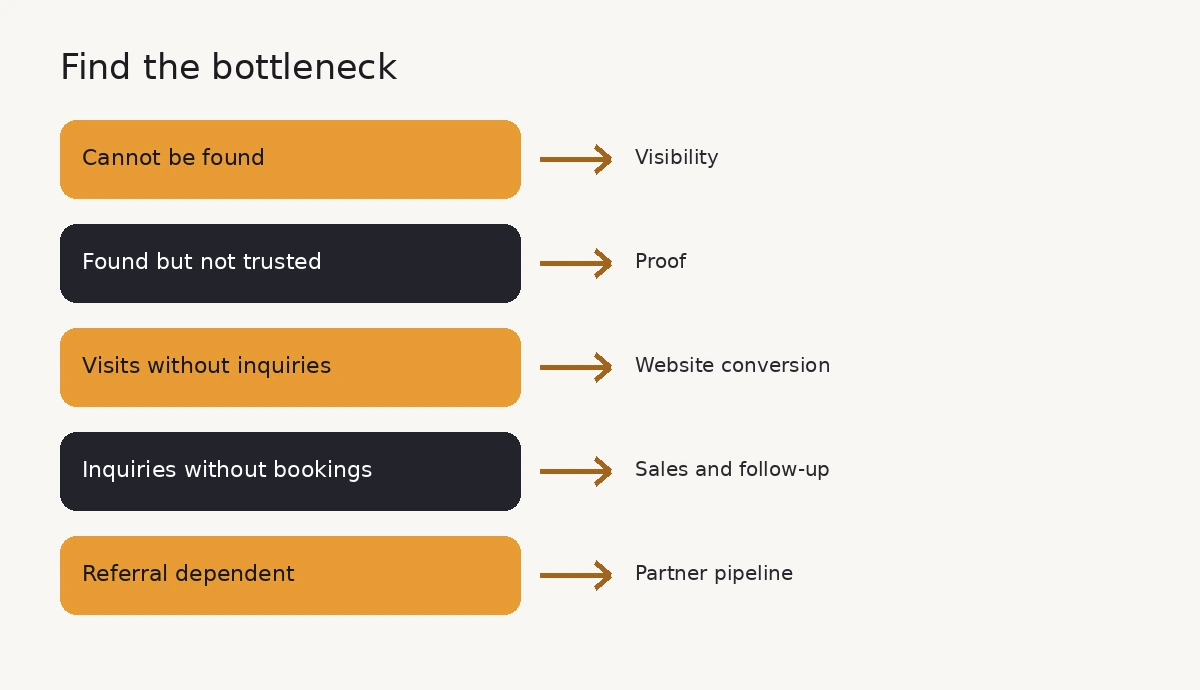
Find Your Marketing Bottleneck
Use this diagnostic:
| If you're experiencing... | Focus on... |
|---|---|
| Few people discover you | Visibility |
| People discover you but don't trust you | Proof |
| People visit but don't inquire | Website conversion |
| Inquiries aren't progressing | Response & qualification |
| Quotes aren't becoming bookings | Offer & follow-up |
| You're heavily dependent on referrals | Acquisition channels |
| Marketing feels unpredictable | Measurement & pipeline |
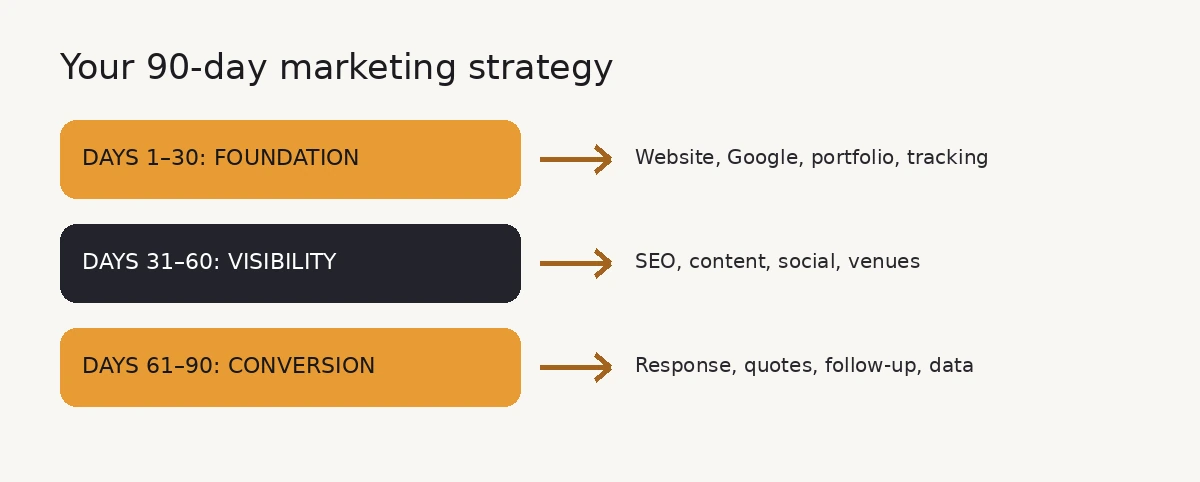
Build the Strategy Over 90 Days
Trying to change everything simultaneously makes marketing difficult to measure.
Build it in stages.
Days 1–30 — Foundation
Review:
- Website
- Google Business Profile
- Services
- Locations
- Portfolio
- Reviews
- Inquiry process
- Existing lead sources
Fix the most obvious gaps.
Days 31–60 — Visibility & Relationships
Build:
- Search-focused content
- Local content
- Social content
- Venue relationships
- Planner relationships
- Referral opportunities
Start tracking where inquiries originate.
Days 61–90 — Conversion & Optimization
Improve:
- Response process
- Quote presentation
- Follow-up
- Website conversion
- Lead tracking
- Content performance
Then use what you learn to decide what deserves more attention.
What Should You Work on First?
If you're difficult to find:
Start with local visibility, search, and content.
If people find you but aren't convinced:
Strengthen your portfolio, reviews, case studies, and proof.
If people visit but don't inquire:
Improve your website messaging, service pages, and conversion path.
If inquiries aren't becoming quotes:
Improve response and qualification.
If quotes aren't becoming bookings:
Review the offer, presentation, objections, and follow-up.
If bookings happen but the pipeline isn't predictable:
Build additional acquisition channels and better measurement.
Don't start with the tactic that sounds most exciting.
Start with the biggest constraint.
Frequently Asked Questions
What is the best marketing strategy for an event lighting company?
A strong strategy connects visibility, trust, website conversion, response, quoting, follow up, and booking rather than treating each channel independently.
How should an event lighting company choose its marketing channels?
Start with your target customer and current marketing bottleneck. Choose channels that solve that specific problem instead of trying to maintain every possible channel.
Should an event lighting company focus on SEO or social media?
They serve different purposes. Search can help capture people actively looking for relevant services, while social media can create visual discovery and proof. They can work together as parts of one system.
How important are venue partnerships?
Venues and planners can connect lighting companies with people already involved in planning events. Building useful relationships can create opportunities beyond direct consumer marketing.
How often should an event lighting company create content?
Consistency matters more than an arbitrary posting frequency. Build a sustainable system around real projects, customer questions, educational topics, and useful visual content.
How do I know whether my marketing strategy is working?
Track the journey from source to inquiry, quote, and booking. The goal is to understand which activities create qualified opportunities and where those opportunities are being lost.
The LitBooked Takeaway
A marketing strategy isn't a list of things your company should post, publish, or promote.
It's a connected system.
Get found. Get trusted. Get contacted. Get considered. Get booked.
Then measure what happens at every stage.
If visibility is the problem, improve visibility.
If trust is the problem, improve proof.
If conversion is the problem, improve the website.
If sales are the problem, improve response, quoting, and follow-up.
And if the system works but the pipeline remains unpredictable, build more reliable acquisition channels.
The goal isn't to do more marketing.
It's to build a marketing system that makes the path from discovery to booking clearer, more measurable, and more repeatable.